Tuesday, November 15, 2011

Just Keep Swimming

Journeys and quests can be defined as travelling from one place to another. These voyages take up a significant amount of time and are filled with obstacles and lessons to be learned. One Disney movie that features the qualities of a quest or journey is Finding Nemo. In this movie, Nemo does not listen to his dad, Marlin, when he tells him not to go "touch the butt" which is actually a fishing boat. As Nemo swims over and disobeys his father he is caught in a fishing net beginning the journey of Marlin and Dory finding Nemo.
Throughout this journey, both Nemo and Marlin learn important information about each other that they did not see before. Nemo is stuck in a dentist's fish tank with other various fish who help him devise a plan to escape and go back to the ocean. Nemo realizes that even though his father was over protective he was just trying to keep his son safe. As Marlin searches through the ocean with Dory, he faces sharks and jellyfish that make their journey harder than planned. Marlin discovers that some times parents just have to learn to let go and give their children some freedom so that they can grow.
Finding Nemo is just one example of a story about a quest out of many. These types of stories are so popular because everybody goes through some sort of journey throughout their own life. Facing fears and overcoming obstacles to get to your destination, whether it being a physical or mental one, occurs every day. Quests and journeys are a learning experience that teach people about themselves and the other people surrounding them. Just like Dory's annoying song that she sings to Marlin, in order to get to our final destination we must "just keep swimming."

A 17-Year Journey


Quests are some of the most famous stories of all time. Stories with a hero, an antagonist, a destination, a reason to go there, and challenges along the way. These types of stories are always appealing, but why? Maybe because the hero typically overcomes an evil character? Nah. Maybe because the hero overcomes some bad-ass feats and destroys the antagonist in some epic battle? Yes, that's got to be it.

Harry Potter is definitely my all-time favorite quest. It's pretty popular so I won't waste time giving you a synopsis. Basically, what makes it a quest is that it has a hero (Harry), an antagonist (Voldemort), a destination (well, more like a feat, which is defeating the person trying to murder him), a reason to go there (ending evil in the wizarding world), and challenges along the way (his friends dying, fighting off Voldemort, and tasks like retrieving the sorcerer's stone, slaying the basilisk, freeing an innocent prisoner, fighting Voldemort, fighting Voldemort, watching another friend die, and eventually defeating Voldemort). That's about as questy as it gets for any readers.

Quest story


Journey and quest stories have become wildly popular because they allow for people to use their imaginations. When people or characters are taken outside of their element the reader gets to see what lies deep down in the heart of the character. This intrigues people because often time’s people spend their whole lives without ever knowing what they are made of and to what limit they can be pushed. Typical elements of journey stories often include a longing for home or just the opposite, a desire to stay away. There are often trials faced by the main character that he or she could not have imagined. One of my favorite quest stories is the Lord of The Rings. What makes this story a quest story is that it is built around the goal to return the ring. A less obvious example of a quest story is the story, A Beautiful Mind. The main character is taken out of his element and into a new world. He struggles with finding a place in just one world. Eventually he conquers his scitsofrenia efficiently ending his quest for sanity. Quest stories are so intriguing because they go above and beyond a normal story.

Archetypal Journey


The hero's journey is a pattern that can be found in myths, stories, and legends from a range of cultures and time periods. Ancient hero's journeys were not created with an awareness of the pattern. Modern hero's journeys are created with an awareness of the pattern and have been criticized for following the pattern too closely.

Nonetheless, there's a reason that this archetype keeps reappearing. Both the ancient and modern hero represent an able-bodied being that is capable of dealing with situations that "normal" people feel they cannot. As humans, we generally desire all stories to have a so called happy ending because it makes us feel optimistic about life. Whether it be unrealistic situations, such as movies like Star Wars, or even movies involving talking animals such as Finding Nemo, there is always a protagonist and the end almost always has a resolution. The one exception I have found is in horror films, which are meant to leave the audience feeling uneasy and continually scared after the film is over. That is often why the end result is not always the death of the antagonist and why horror films often have sequels.

The most prominent element, other than a physical journey, is quite obviously the spiritual or emotional journey that the main character makes. Whether it's finding love or finding yourself, the character almost always makes some sort of discovery or else the plot line would be essentially flat. These stories also have intended lessons and moral teachings, though most people perceive plots at face value.

My most favorite journey story is Match Point. Although somewhat atypical, it still can follow along the archetype.

Protagonist : Chris- Comes from poor background
Conflict: Affair with Nola & her pregnancy with his child
Solution: Remove Nola from the picture
Theme: Luck


Trailer


Opening Scene


Final Scene


Monday, November 14, 2011

Antigone


In literature, a journey serves as a “plot device” used to further develop the storyline. What is it about a story that stimulates our interest in journeys? What is it about a journey that leaves readers itching for more yet leaves readers discontent if a story lacks one? In some cases, readers simply want to be encouraged. There lies deep satisfaction in a storyline wherein a character, removed from his known world, must venture into the unknown to demonstrate inspiring courage, spirit, and confidence to confront his own personal hardship. The reader observes how the journey has shaped the character’s growth and admires his ability to persist in the face of difficulty. Now able to empathize and identify with the character, the reader feels more inclined to journey toward his/her own hardships and, like the character in the story, is motivated to survive and prosper despite all odds.

In other instances, readers crave a storyline that explores the dark side of a journey and introduces emotional conflict so intense that it keeps the reader turning pages. Some types of these “quest texts” encompass tragic journeys wherein the protagonist, though of a good heart and of likeable character, is slayed for performing actions and holding beliefs that contradict those of authorities/ society.


My favorite “quest text” is a play called Antigone, a tragedy written by Sophocles in 442 BC. This play centers on the Theban princess, Antigone, who goes against Creon’s authoritative proclamation stating that her brother, Polynieces, must lie unburied and open to desecration by the vultures and the dogs. Caught in a precarious dilemma, Antigone must decide where her loyalty lies: with her King or with her kin. Although fully aware that defying Creon could result in her death, she surrenders to her moral obligation to honor her brother and performs the burial procedures allowing his soul to cross over to the underworld. In doing so, she has sacrificed her life for that of her brother’s eternal well-being in. As she walks to her death, Antigone’s journey ends with an inspiring nobleness and spiritedness as she holds firm in her belief to protect her kin.

Tuesday, November 8, 2011

Restless Blood


“[B]ut at the instant I saw that the cut had bled a little, and the blood was trickling over my chin. … When the Count saw my face, his eyes blazed with a sort of demoniac fury, and he suddenly mad e a grab at my throat. … ‘Take care,’ he said, ‘take care how you cut yourself. It is more dangerous than you think in this country.’”


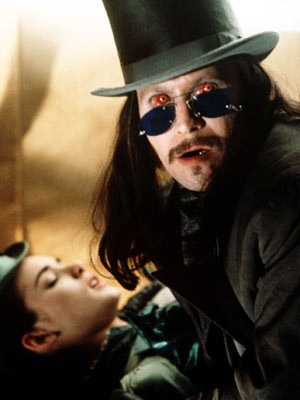
Blood is a major moving force throughout Dracula. Blood literally drives the book’s monstrous namesake to do what he does—murdering seamen, seducing women, kidnapping children, among many other atrocities—for without blood, Count Dracula would wither into a brittle old man. The effect blood has not only on Dracula’s, but also other characters’, moods throughout the book makes an interesting statement about blood, aside from its universal connections with life and death.

Evident in scenes like the one above, blood does not put people, fictional and nonfictional, exactly at ease. There is nothing ever calming, or at the very least serene, about blood. Even when Lucy is rejuvenated with blood transfusions, she is either vibrant with new blood, or at death’s door without it. Here, the sight of blood draws the baser instincts out of Dracula, causing his “demoniac fury” before he could even taste Jonathan’s blood. Similarly, Renfield turns almost pentacostal when he cuts Seward’s wrist for blood.


From blood comes the many connotations we associate with the organic liquid today—life/death, passion, kin, etc. But what about blood itself causes us to make those associations so readily? Bram Stoker seems to attempt answering this with the many encounters and instances with blood and his characters. Blood is a mover and shaker, never letting characters rest in its presence (or its absence). Blood, after all, ever rests in our veins, and the characters’ reactions towards blood seem to reflect blood’s own restlessness.

That Time of the Month

               
                I’ve decided to discuss the sexual connotations of blood used within the novel. Fertility is one of the concepts we discussed, and fertility is related to sex. There are a few scenes that almost show a sexual progression through blood.
                The first scenes that come to mind make up the sequence of blood transfusions given to Lucy. I think that Stoker’s choice of having the men that loved her give the transfusions give the acts a more sexual implication. Also, the act is an exchange of fluids, namely from the man to the woman. The men get worn out after, and the act is also seen as something that would anger her fiancĂ© if he found out another man did it; two things that make the transfusions seem like an allusion to sex.
                The time that the idea of fertility can be seen more in the story is when Dracula forces Mina to drink his blood. He transfers his blood into her, and because of that she becomes “pregnant” with the evil. Once the fluid is within her, a new part of her begins to form. The vampire-ness was passed onto her through bodily fluid and began to develop within her, much like a fetus resulting from a sex act. Speaking of sex act, the scene within the book did seem very much like a sexual event, a rape even.
                “With his left hand [the Count] held both Mrs. Harker’s hands, keeping them away with her arms at full tension; his right hand gripped her by the back of the neck, forcing her face down on his bosom. Her white nightdress was smeared with blood, and a thin stream trickled down the man’s bare breast which was shown by his torn-open dress.”
                Another way blood shows fertility in the story is when it is consumed the receiver becomes more fertile looking. Youth is gained by Dracula, and youth is a great sign of fertility. Also, in Lucy’s case, when she receives blood she becomes healthier, livelier, and rosier, all signs of fertility.
                Fertility is only one of the many interesting things blood can be expressing within the story of Dracula.